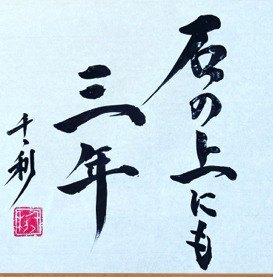
石の上にも三年
ishi no ue ni mo san-nen
In Japan, when someone starts a new job or a hard lesson and wants to quit, people often say: ishi no ue ni mo san-nen (石の上にも三年) – “three years on a stone.”
I’m Arasen, an elementary school principal and calligrapher in Japan. This plain-looking proverb is one of my favorites. Let me tell you why.
Quick Facts
| Japanese | 石の上にも三年 |
|---|---|
| Reading | いしのうえにもさんねん |
| Romaji | ishi no ue ni mo san-nen |
| Literally | Even on a stone, three years |
| Meaning | Be patient and keep going – your effort will be rewarded. |
| English cousin | Perseverance prevails. / Rome wasn’t built in a day. |
What Does It Mean?
Even when things are hard, if you keep working patiently, your effort will surely be rewarded.
Japanese people often use it to encourage someone in the early, difficult stage of a job, a sport or study.
Word by Word
| 石 | ishi – stone |
|---|---|
| の上にも | no ue ni mo – even on top of |
| 三年 | san-nen – three years (here it means “a long time”) |
Where Does It Come From?
Picture a cold stone. If you sit on it for a moment, it stays cold. But if you keep sitting on it for three whole years, your body heat will warm it up.
So “three years” here is not an exact number – it means “a long time.” Keep going patiently, and even something cold and hard will change.
A Word from Arasen

If you keep sitting on a cold stone for three years, it will become warm. If you keep making a patient effort, you will surely be rewarded. It’s a plain proverb, but I love it.
In study or in lessons, there are many failures at first, and you don’t improve quickly. Sometimes you’ll feel it’s too hard, or you’ll want to give up.
But with the spirit of ishi no ue ni mo san-nen, you can get through it!
The key is the exciting promise: “You will be rewarded.”
Let’s use this proverb with hope!
(Translated from Arasen’s original Japanese.)
How to Use It
A Short Skit

Kyoko, did you hear? Takuya in the class next door is taking the bar exam to become a lawyer.
今日子、隣のクラスの拓哉くん、弁護士の国家試験に挑戦してるんだってNozomi, I know! Everyone’s talking about it. The bar exam is really hard, right? Takuya is amazing.
のぞみ、知ってるで。みんなうわさしてるもん。弁護士の試験って難しいんでしょ。拓哉くんって、本当にすごいねぇ。He really is. Takuya says, “Ishi no ue ni mo san-nen. I’ll keep at it patiently.” I respect him so much.
ほんと、すごいよね。拓哉くんは『石の上にも三年。辛抱強く頑張るわ』って言ってるんだって。尊敬するわ“Chan-chan” is the little “ta-da!” sound that closes a comedy skit in Japan.
Example Sentences
- My piano playing wasn’t getting better, but I practiced every day, thinking ishi no ue ni mo san-nen.
なかなか上達しないピアノも、石の上にも三年と思って毎日練習を続けた。 - My brother was a substitute when he joined the club, but – ishi no ue ni mo san-nen – he was a starter in his last tournament.
入部したころは補欠だった兄も、石の上にも三年で、最後の大会ではレギュラーになった。
Similar Japanese Proverbs
- 雨垂れ石を穿つAmadare ishi o ugatsu
“Raindrops wear through stone.” Even a small effort, repeated patiently, can achieve something big. - 継続は力なりKeizoku wa chikara nari
“Continuing is power.” Simply keeping at it becomes your strength. - ちりも積もれば山となるChiri mo tsumoreba yama to naru
“Even dust, piled up, becomes a mountain.”
The Opposite
- 三日坊主Mikka bōzu
“A three-day monk” – someone who gives up on everything after three days. The exact opposite!
Similar Sayings in English
- Perseverance prevails.
- Rome wasn’t built in a day.
Other countries have the same wisdom: a Korean proverb says “Stare at a stone for ten years and it will have a hole,” and a French one says that with time and patience, anything can be done.
Quick Quiz
In ishi no ue ni mo san-nen, what does “three years” (三年) mean?
- A. exactly three years
- B. a long time
- C. doing something three times
Show the answer
The answer is B. a long time. “Three years” is a way of saying “a long period.”
Free Worksheet for Teachers
Teaching Japanese? Download a free printable worksheet for this proverb – with the skit, a fill-in-the-blank, a quiz and a writing task (10 proverbs, A4, with answer key).
Read More
- 30 Japanese Proverbs (Kotowaza) with Meanings – all in one place
- Nanakorobi Yaoki (七転び八起き) – Fall Seven Times, Stand Up Eight
- Senri no Michi mo Ippo kara (千里の道も一歩から) – A Journey of a Thousand Miles Begins with One Step
- Koketsu ni Irazunba Koji o Ezu (虎穴に入らずんば虎子を得ず) – If You Don’t Enter the Tiger’s Den, You Can’t Catch Its Cub
- 石の上にも三年(日本語の記事)
- ことわざ 目次(250+ proverbs in Japanese)