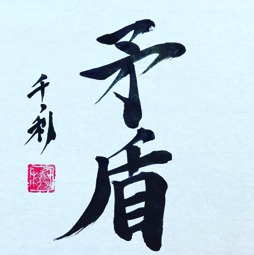
矛盾
mujun
Every Japanese speaker uses the word mujun (矛盾) – “contradiction.” But look at the two kanji: spear and shield.
I’m Arasen, an elementary school principal and calligrapher in Japan. Behind this ordinary word is a funny story from ancient China. Here it is.
Quick Facts
| Japanese | 矛盾 |
|---|---|
| Reading | むじゅん |
| Romaji | mujun |
| Literally | Spear + shield |
| Meaning | A contradiction; things that don’t add up. |
| Type | Koji seigo – a saying born from an ancient Chinese story |
| Origin | Han Feizi, ancient China |
| English | contradiction |
What Does It Mean?
When what someone says or does doesn’t fit together – it doesn’t add up.
Word by Word
| 矛 | mu (hoko) – a spear, a pike |
|---|---|
| 盾 | jun (tate) – a shield |
Where Does It Come From?
Long ago in the Chinese state of Chu, a man sold spears and shields.
Selling his spear, he said: “My spear is so sharp it can pierce any shield.” Selling his shield, he said: “My shield is so hard that no spear can pierce it.”
Someone asked him: “Then what happens if you strike your shield with your spear?” The man couldn’t answer.
The story appears in the ancient Chinese book Han Feizi.
A Word from Arasen

Mujun means “things that don’t add up” or “things that can’t both be true.”
Isn’t it amazing that a word we use every day without thinking was born from such a drama?
Is there anyone around you whose words and actions don’t match? If so, tell them: “That’s a mujun!”
(Translated from Arasen’s original Japanese.)
How to Use It
A Short Skit
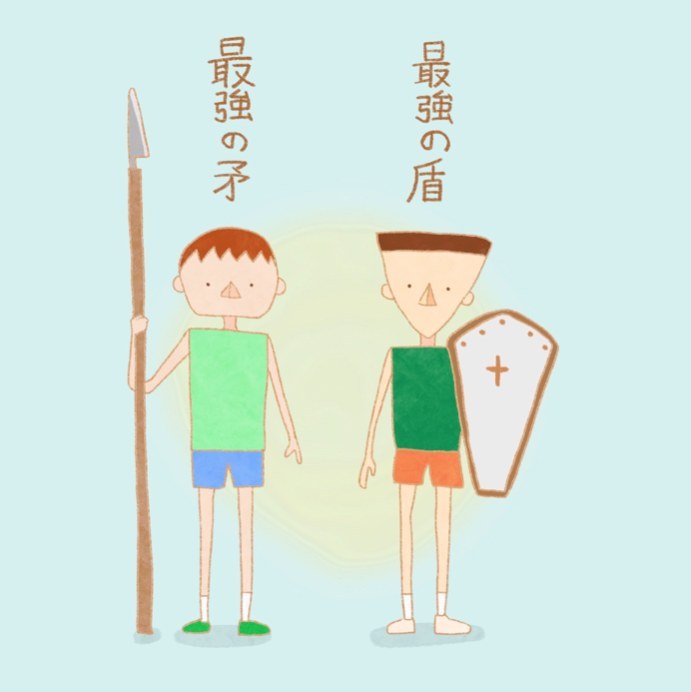
Hey, please listen to me.
おい、ちゃんと聞いてくれよ。I’ve had enough of your excuses. Your story is full of mujun – it doesn’t make sense.
言い訳はもうたくさんや。君の話は矛盾だらけで、筋が通っていないよ。“Chan-chan” is the little “ta-da!” sound that closes a comedy skit in Japan.
Example Sentences
- Dad says “Go to bed early” while watching TV until late at night. That’s a mujun.
「早く寝なさい」と言いながら、夜おそくまでテレビを見ているお父さんの行動は矛盾している。 - There was a mujun in the suspect’s story, so the lie came out.
犯人の説明には矛盾があったので、うそがばれた。
Similar Japanese Proverbs
- つじつまが合わないTsujitsuma ga awanai
“The seams don’t meet.” The story doesn’t add up. - 自家撞着Jika dōchaku
“Colliding with oneself.” Saying something that clashes with what you said before.
The Opposite
- 首尾一貫Shubi ikkan
“Consistent from head to tail.” Logical and consistent from beginning to end.
Similar Sayings in English
- contradiction
- That’s a contradiction.
- an irresistible force meets an immovable object
The English “irresistible force paradox” asks the very same question as the spear and the shield!
Quick Quiz
What was the man in the story selling?
- A. A bow and arrows
- B. A spear and a shield
- C. A sword and armor
Show the answer
The answer is B. A spear and a shield – one that pierces anything, one that nothing can pierce.
Watch the Lesson (in Japanese)
On my YouTube channel “Kyō kara tsukaeru kotowaza kōza” (Proverbs You Can Use from Today), I explain proverbs with short comedy skits. It’s in Japanese – a fun challenge for learners!
Free Worksheet for Teachers
Teaching Japanese? Download a free printable worksheet for this proverb – with the skit, a fill-in-the-blank, a quiz and a writing task (10 proverbs, A4, with answer key).
Read More
- 50 Japanese Proverbs (Kotowaza) with Meanings – all in one place
- Ryoyaku wa Kuchi ni Nigashi (良薬は口に苦し) – Good Medicine Tastes Bitter
- Kobo Fude o Erabazu (弘法筆を選ばず) – Kobo Doesn’t Choose His Brush
- Oni no Me ni mo Namida (鬼の目にも涙) – Even an Ogre Has Tears in Its Eyes
- 矛盾(日本語の記事)
- ことわざ 目次(250+ proverbs in Japanese)