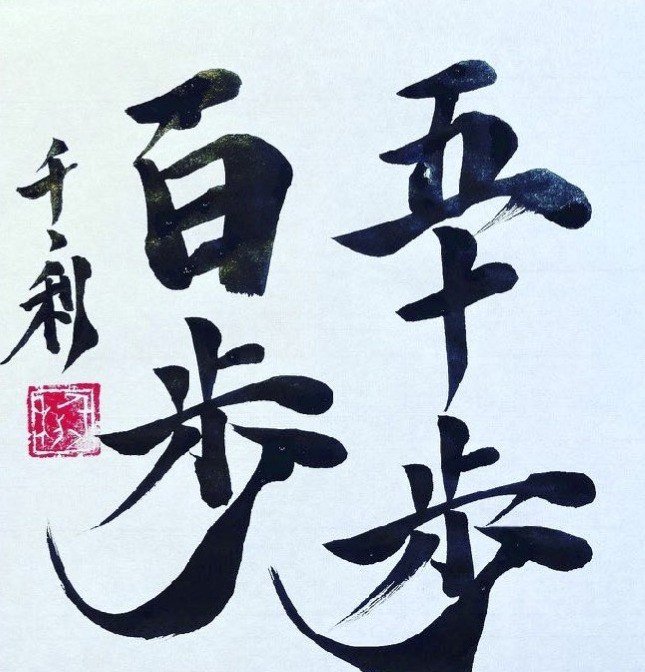
五十歩百歩
gojippo hyappo
Laughing at a friend who got 30 points – when you got 45? Japanese would say that’s gojippo hyappo (五十歩百歩).
I’m Arasen, an elementary school principal and calligrapher in Japan. It comes from a story told by the Chinese philosopher Mencius, about soldiers running away from battle.
Quick Facts
| Japanese | 五十歩百歩 |
|---|---|
| Reading | ごじっぽひゃっぽ |
| Romaji | gojippo hyappo |
| Literally | Fifty steps, a hundred steps |
| Meaning | There’s only a tiny difference – they’re basically the same. |
| Origin | Mencius, ancient China |
| Opposite | 月と鼈 (tsuki to suppon) – “the moon vs. a turtle” |
| English cousin | Six of one, half a dozen of the other. |
What Does It Mean?
Only a small difference, with no real gap between them.
It is often used for laughing at someone who is really no better or worse than you.
Word by Word
| 五十歩 | gojippo – fifty steps |
|---|---|
| 百歩 | hyappo – a hundred steps |
Where Does It Come From?
On a battlefield, a soldier who ran away fifty steps laughed at another who ran away a hundred steps, calling him a coward.
But both had run away – there was no real difference.
It is a shortened form of “laughing at a hundred steps with fifty steps,” from the book of the philosopher Mencius, who followed the teachings of Confucius.
A Word from Arasen

It comes from the phrase “laughing at a hundred steps after taking fifty.”
It means sneering at someone who is hardly different from you, as if they were worse. But you’re just about the same – no real difference. It means the same as “they’re as bad as each other.”
Student A got 45 on his English test. Back at his seat, he looks at Student B’s test and says, “Whoa! You only got 30? That’s bad!”
But 45 and 30 – they’re both about the same, aren’t they?
Someone like Student A is gojippo hyappo.
The original story is in a book of the teachings of Mencius, who followed Confucius. A little trivia!
When do I think “That’s gojippo hyappo!”? When my daughter asks me in a clothes shop, “Which one is better?” Both look great on her – no real difference. In that case, it has a nice meaning!
(Translated from Arasen’s original Japanese.)
How to Use It
A Short Skit
Yusuke, which way is quicker to the station – right or left?
勇輔くん、駅に行くには、右左、どちらの道が早いのかな?Well, whichever road you take, the distance to the station is gojippo hyappo.
まあ、どちらの道を通っても、駅までの距離は、五十歩百歩やろうなぁ。“Chan-chan” is the little “ta-da!” sound that closes a comedy skit in Japan.
Example Sentences
- The two late students are arguing, but five minutes late or ten minutes late is gojippo hyappo.
遅刻した二人が言い合っているが、五分おくれも十分おくれも五十歩百歩だ。 - My room and my brother’s room were both messy – gojippo hyappo.
ぼくも弟も部屋がちらかっていて、五十歩百歩だった。
Similar Japanese Proverbs
- どんぐりの背比べDonguri no seikurabe
“Acorns comparing their height.” All about the same, none outstanding. - 目くそ鼻くそを笑うMekuso hanakuso o warau
“Eye gunk laughing at nose gunk.” Laughing at others’ faults while ignoring your own.
The Opposite
- 月と鼈Tsuki to suppon
“The moon and a soft-shell turtle.” Both round, but worlds apart.
Similar Sayings in English
- Six of one, half a dozen of the other.
- The pot calling the kettle black.
- A miss is as good as a mile.
Quick Quiz
In the story, what were the soldiers doing when they took fifty and a hundred steps?
- A. Charging at the enemy
- B. Running a race
- C. Running away from the battle
Show the answer
The answer is C. Both soldiers ran away – so there was no real difference.
Watch the Lesson (in Japanese)
On my YouTube channel “Kyō kara tsukaeru kotowaza kōza” (Proverbs You Can Use from Today), I explain proverbs with short comedy skits. It’s in Japanese – a fun challenge for learners!
Free Worksheet for Teachers
Teaching Japanese? Download a free printable worksheet for this proverb – with the skit, a fill-in-the-blank, a quiz and a writing task (10 proverbs, A4, with answer key).
Read More
- 50 Japanese Proverbs (Kotowaza) with Meanings – all in one place
- Saru mo Ki kara Ochiru (猿も木から落ちる) – Even Monkeys Fall from Trees
- I no Naka no Kawazu (井の中の蛙大海を知らず) – A Frog in a Well Knows Nothing of the Great Ocean
- Fukusui Bon ni Kaerazu (覆水盆に返らず) – Spilled Water Never Returns to the Tray
- 五十歩百歩(日本語の記事)
- ことわざ 目次(250+ proverbs in Japanese)