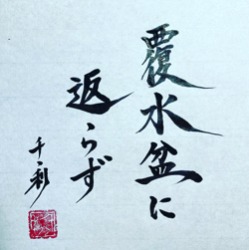
覆水盆に返らず
fukusui bon ni kaerazu
Have you ever wished you could take something back? Japanese has a proverb for that moment: fukusui bon ni kaerazu (覆水盆に返らず).
I’m Arasen, an elementary school principal and calligrapher in Japan. Let me tell you the surprising love story behind it – and why I think it’s really a message of hope.
Quick Facts
| Japanese | 覆水盆に返らず |
|---|---|
| Reading | ふくすいぼんにかえらず |
| Romaji | fukusui bon ni kaerazu |
| Literally | Spilled water does not return to the tray |
| Meaning | Once something is done, it can’t be undone. |
| English cousin | It’s no use crying over spilt milk. |
What Does It Mean?
Once something has happened, it can never be undone.
Originally it meant that a broken marriage cannot be put back together. Today it is used for any mistake that can’t be taken back.
Word by Word
| 覆水 | fukusui – spilled water |
|---|---|
| 盆 | bon – a tray |
| に返らず | ni kaerazu – does not return to (an old way of saying kaeranai) |
Where Does It Come From?
The saying comes from a legend about Taigong Wang (太公望), a wise man in ancient China.
He spent all his time reading books instead of working, so his wife gave up and left him. Later he became a great and powerful man – and his former wife came back, asking to start again.
He poured a tray of water onto the ground and said, “If you can put this water back in the tray, we can start again.” Of course, nobody can.
A Word from Arasen

Once something has happened, you can’t put it back the way it was.
Say you broke a vase your father treasured. However hard you try to fix it, it will never be the same. Just like this proverb says.
I have made plenty of mistakes in my life, too. I’ve often thought, “Please, turn back time!” But what’s done is done.
So make up for it in a different way. Don’t keep crying about it – let’s keep going!
(Translated from Arasen’s original Japanese.)
How to Use It
A Short Skit

Aaaah! I washed my white gym clothes together with a red shirt!
わぁああああ。白い体操服を赤色のシャツと一緒に洗濯してしまった!!Oh no… they’ve turned pink. That’s fukusui bon ni kaerazu.
うあ。ピンク色になってるわ。覆水盆に返らずやわ。“Chan-chan” is the little “ta-da!” sound that closes a comedy skit in Japan.
Example Sentences
- Words, once spoken, can’t be taken back. Fukusui bon ni kaerazu.
言ってしまった言葉は取り消せない。覆水盆に返らずだ。 - They say fukusui bon ni kaerazu, so let’s check carefully before we leave.
覆水盆に返らずというから、出かける前によく確認しよう。
Similar Japanese Proverbs
- 後悔先に立たずKōkai saki ni tatazu
“Regret never comes first.” Once it’s over, regret can’t fix it.
Similar Sayings in English
- It’s no use crying over spilt milk.
- What’s done is done.
Quick Quiz
Whose story is fukusui bon ni kaerazu based on?
- A. Confucius
- B. Kōbō Daishi
- C. Taigong Wang
Show the answer
The answer is C. Taigong Wang, a wise man of ancient China who poured out a tray of water.
Watch the Lesson (in Japanese)
On my YouTube channel “Kyō kara tsukaeru kotowaza kōza” (Proverbs You Can Use from Today), I explain proverbs with short comedy skits. It’s in Japanese – a fun challenge for learners!
Free Worksheet for Teachers
Teaching Japanese? Download a free printable worksheet for this proverb – with the skit, a fill-in-the-blank, a quiz and a writing task (10 proverbs, A4, with answer key).
Read More
- 30 Japanese Proverbs (Kotowaza) with Meanings – all in one place
- Saru mo Ki kara Ochiru (猿も木から落ちる) – Even Monkeys Fall from Trees
- I no Naka no Kawazu (井の中の蛙大海を知らず) – A Frog in a Well Knows Nothing of the Great Ocean
- No Aru Taka wa Tsume o Kakusu (能ある鷹は爪をかくす) – The Skilled Hawk Hides Its Talons
- 覆水盆に返らず(日本語の記事)
- ことわざ 目次(250+ proverbs in Japanese)