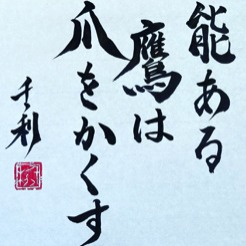
能ある鷹は爪をかくす
nō aru taka wa tsume o kakusu
In Japan, being humble about your talents is often seen as cool. The perfect proverb for this is nō aru taka wa tsume o kakusu (能ある鷹は爪をかくす).
I’m Arasen, an elementary school principal and calligrapher in Japan. Have you ever been surprised to discover a quiet friend’s hidden talent? Then you already know this proverb.
Quick Facts
| Japanese | 能ある鷹は爪をかくす |
|---|---|
| Reading | のうあるたかはつめをかくす |
| Romaji | nō aru taka wa tsume o kakusu |
| Literally | A capable hawk hides its claws |
| Meaning | Really talented people don’t show off. |
| English cousin | Still waters run deep. |
What Does It Mean?
People with real talent don’t go around showing it off.
They keep it quiet – and then show their skill at exactly the right moment.
Word by Word
| 能ある | nō aru – skilled, capable |
|---|---|
| 鷹 | taka – hawk |
| は爪を | wa tsume o – its claws, talons |
| かくす | kakusu – to hide |
Where Does It Come From?
A hawk that is good at hunting keeps its sharp talons hidden until the very moment it catches its prey.
From this came the idea that truly capable people don’t show their power until it’s needed.
A Word from Arasen

“What? She speaks English fluently?!” “You had that skill? I never knew!” Have you ever been surprised like that?
Not showing off, and then shining when it really counts – that’s cool, isn’t it?
A good hunting hawk spots its prey from high above, dives down and catches it without a wasted move. Until the moment it grabs its prey, it keeps its sharp talons hidden.
And if you’re thinking, “I don’t have any talent to hide!” – then let’s start polishing one now.
(Translated from Arasen’s original Japanese.)
How to Use It
A Short Skit

Wow! Rie took this photo? It’s amazing – like a pro!
え!!この写真!理恵が撮った写真なの、すごい!プロ級だよIt really is. I had no idea Rie was this good. Nō aru taka wa tsume o kakusu!
ほんまやすごいなぁ。理恵が撮った写真がこんなに上手いとは知らなかったわ。まさに、能あるたかは爪を隠すよね~“Chan-chan” is the little “ta-da!” sound that closes a comedy skit in Japan.
Example Sentences
- The quiet girl in our class won the piano competition. Nō aru taka wa tsume o kakusu.
いつもおとなしい彼女が、ピアノコンクールで優勝した。能ある鷹は爪をかくすだ。 - Nō aru taka wa tsume o kakusu – truly strong people don’t brag.
能ある鷹は爪をかくすで、本当に強い人は自慢しない。
Similar Japanese Proverbs
- 実るほど頭を垂れる稲穂かなMinoru hodo kōbe o tareru inaho kana
“The more the rice ripens, the lower it bows its head.” The greater the person, the humbler they are.
Similar Sayings in English
- Still waters run deep.
- Empty vessels make the most noise.
In Indonesia they say “The tiger hides its claws,” and in China, “A good dog doesn’t jump, a good cat doesn’t meow.”
Quick Quiz
What does nō aru taka wa tsume o kakusu mean?
- A. Hawks take care of their claws
- B. Talented people don’t show off
- C. Talented people always stand out
Show the answer
The answer is B. Truly skilled people don’t brag about it.
Watch the Lesson (in Japanese)
On my YouTube channel “Kyō kara tsukaeru kotowaza kōza” (Proverbs You Can Use from Today), I explain proverbs with short comedy skits. It’s in Japanese – a fun challenge for learners!
Free Worksheet for Teachers
Teaching Japanese? Download a free printable worksheet for this proverb – with the skit, a fill-in-the-blank, a quiz and a writing task (10 proverbs, A4, with answer key).
Read More
- 30 Japanese Proverbs (Kotowaza) with Meanings – all in one place
- Saru mo Ki kara Ochiru (猿も木から落ちる) – Even Monkeys Fall from Trees
- I no Naka no Kawazu (井の中の蛙大海を知らず) – A Frog in a Well Knows Nothing of the Great Ocean
- Fukusui Bon ni Kaerazu (覆水盆に返らず) – Spilled Water Never Returns to the Tray
- 能ある鷹は爪をかくす(日本語の記事)
- ことわざ 目次(250+ proverbs in Japanese)