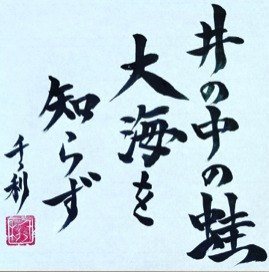
井の中の蛙大海を知らず
i no naka no kawazu taikai o shirazu
Imagine a little frog living at the bottom of a well. It looks up at a small circle of sky and thinks, “This is the whole world!” That is i no naka no kawazu taikai o shirazu (井の中の蛙大海を知らず).
I’m Arasen, an elementary school principal and calligrapher in Japan. This proverb is a gentle reminder for all of us – children and adults alike.
Quick Facts
| Japanese | 井の中の蛙大海を知らず |
|---|---|
| Reading | いのなかのかわず たいかいをしらず |
| Romaji | i no naka no kawazu taikai o shirazu |
| Literally | The frog in the well does not know the great sea |
| Meaning | Having a narrow view without knowing how big the world is. |
| Short form | 井の中の蛙 (i no naka no kawazu) |
| English cousin | A frog in a well knows nothing of the great ocean. |
What Does It Mean?
Having a narrow way of seeing and thinking, without knowing how wide the world really is.
People often use just the first half, i no naka no kawazu, to describe someone who is proud of being the best in a small place.
Word by Word
| 井の中の | i no naka no – inside the well (i = an old word for well) |
|---|---|
| 蛙 | kawazu – frog (an old word; today we usually say kaeru) |
| 大海 | taikai – the great ocean |
| 知らず | shirazu – does not know |
Where Does It Come From?
The story comes from the Zhuangzi (荘子), an ancient Chinese book of philosophy. A frog living in a narrow well can’t imagine the great sea, because it has never seen anything outside its well.
Fun fact: in Japan, some people add a second line – されど空の深さを知る – “but it knows how deep the sky is.” It’s a later addition, but it gives the little frog a nice reply!
A Word from Arasen

The world is wide. Even in the things we are good at, there is still so much we don’t know.
And yet if you puff yourself up – “I’m amazing!” – people will say, “I no naka no kawazu.” It means you see things too narrowly.
A frog living in a narrow well thinks the well is the world, and doesn’t know there is a wide ocean. The saying comes from an old Chinese book, the Zhuangzi.
For example, say you are the star pitcher on your elementary school baseball team. Everyone around you is less skilled, and you start to think, “I’m the best!”
But at other schools, there are surely amazing kids.
Knowing this proverb, you might think, “I still have a long way to go” – and notice how big the world is.
When you meet someone who makes you think “Wow, they’re better than me!”, that is your chance to grow. Go for it!
As for me… I’d like to make my mark inside my own well first!
(Translated from Arasen’s original Japanese.)
How to Use It
A Short Skit
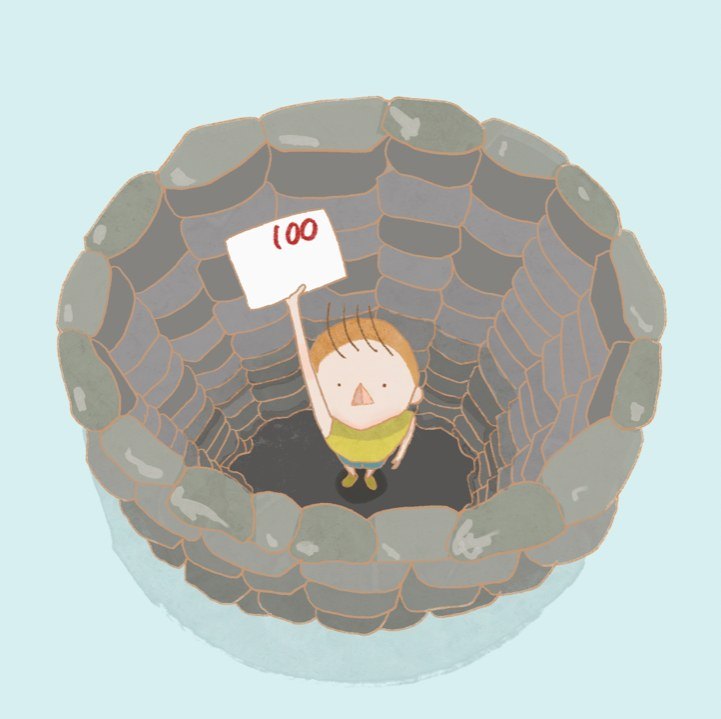
Ha ha ha! I have the best grades in this whole school! Call me “Professor”!
ワハハ!!俺はこの学校で1番の成績だ!!博士って呼びなさいThat’s great – but be careful not to become i no naka no kawazu.
それはすごいけど、井の中の蛙大海を知らず、にならないようにね“Chan-chan” is the little “ta-da!” sound that closes a comedy skit in Japan.
Example Sentences
- I was satisfied after winning the town tournament, but I lost at the national one. I was i no naka no kawazu.
町の大会で一番になって安心していたが、全国大会で負けた。井の中の蛙大海を知らずだった。 - So that we don’t become i no naka no kawazu, let’s listen to all kinds of people’s ideas.
井の中の蛙大海を知らずにならないよう、いろいろな人の考えを聞こう。
Similar Japanese Proverbs
- 葦の髄から天井をのぞくYoshi no zui kara tenjō o nozoku
“Looking at the ceiling through a reed stem.” Judging something big from a very narrow view.
Similar Sayings in English
- A frog in a well knows nothing of the great ocean.
A Mongolian proverb puts it beautifully: “The frog in the well doesn’t know how big the lake is – and the frog in the lake doesn’t know how narrow the well is.”
Quick Quiz
How is 蛙 (frog) read in this proverb?
- A. kaeru
- B. kawazu
- C. a
Show the answer
The answer is B. kawazu. Kawazu is an old word for “frog.”
Watch the Lesson (in Japanese)
On my YouTube channel “Kyō kara tsukaeru kotowaza kōza” (Proverbs You Can Use from Today), I explain proverbs with short comedy skits. It’s in Japanese – a fun challenge for learners!
Free Worksheet for Teachers
Teaching Japanese? Download a free printable worksheet for this proverb – with the skit, a fill-in-the-blank, a quiz and a writing task (10 proverbs, A4, with answer key).
Read More
- 30 Japanese Proverbs (Kotowaza) with Meanings – all in one place
- Saru mo Ki kara Ochiru (猿も木から落ちる) – Even Monkeys Fall from Trees
- Fukusui Bon ni Kaerazu (覆水盆に返らず) – Spilled Water Never Returns to the Tray
- No Aru Taka wa Tsume o Kakusu (能ある鷹は爪をかくす) – The Skilled Hawk Hides Its Talons
- 井の中の蛙大海を知らず(日本語の記事)
- ことわざ 目次(250+ proverbs in Japanese)