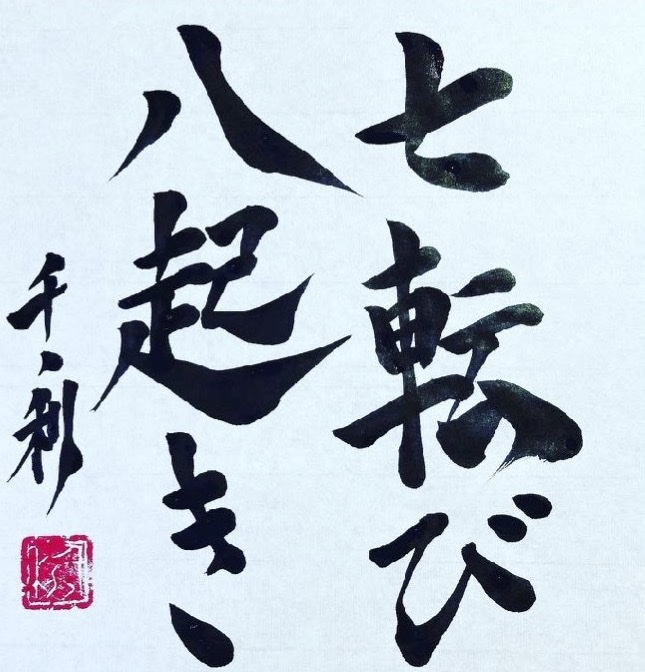
七転び八起き
nana-korobi ya-oki
Have you ever heard the saying “Fall seven times, stand up eight”? It comes from one of Japan’s best-loved proverbs, nanakorobi yaoki (七転び八起き).
I’m Arasen, an elementary school principal and calligrapher in Japan. I have explained more than 250 Japanese proverbs for children on this blog. In this article, I’ll share the meaning, the story behind the words, how Japanese people really use it – and the episode that made this proverb my motto.
Quick Facts
| Japanese | 七転び八起き |
|---|---|
| Reading | ななころびやおき |
| Romaji | nana-korobi ya-oki |
| Literally | Seven falls, eight risings |
| Meaning | Never give up, however many times you fail. |
| Also written | 七転八起 (shichiten-hakki), a four-character idiom |
| English cousin | If at first you don’t succeed, try, try again. |
What Does It Mean?
Even if you fail again and again, don’t lose heart – get back up and keep going.
It is also used to describe life itself: life is full of ups and downs, of falling down and standing up again.
Word by Word
| 七 | nana – seven |
|---|---|
| 転び | korobi – falling down (from korobu, “to fall”) |
| 八 | ya – eight (an old way of reading 八, also heard in yattsu, “eight things”) |
| 起き | oki – getting up (from okiru, “to get up”) |
Where Does It Come From? (And Why Eight?)
The proverb paints a simple picture: you fall down seven times, and you get up eight times.
Here, “seven” doesn’t mean exactly seven. In Japanese, it means “many times” – not just once or twice. “Eight” is simply one more than that. However many times you fall, the last move is always getting up.
In Japan, this spirit is often linked with the Daruma doll (だるま), a round red doll with a weighted bottom. Push it over, and it rocks straight back up. Many people buy a Daruma when they start a big challenge, such as an exam: they paint in one eye when they make their wish, and the other eye when it comes true.
A Word from Arasen

Life has good times, and times when everything falls apart.
This proverb tells us not to give in – even when we fail again and again and think, “That’s it, I’m finished.” What matters is getting back on your feet and finding the strength to try once more.
Whenever I think of this proverb, I remember one story.
It was when I was taking the exam to become a teacher. I failed the first time. I was so discouraged – “Maybe I’ll never pass, no matter how many times I try.” So I went to talk to a senpai, an older colleague who had passed.
He said, “There’s only one way to win.” Desperate, I asked him what it was. “If you keep trying until you win, you’ll win,” he said – with a very proud look on his face.
“Well, obviously!” I said. But then he told me: “Most people give up and walk away after failing a few times. The people who win are the ones who don’t give up until the very end.”
That is exactly nanakorobi yaoki – the person who keeps getting up wins in the end! And yes, I passed the exam after that.
“Fall seven times, stand up eight.” “Keep trying until you win, and you will win.” These are the guiding words of my life.
(Translated from Arasen’s original Japanese.)
How to Use It
A Short Skit
It’s hopeless. There’s no way we can beat that team…
もうあかんわ。あのチームに勝つのは無理や・・・。Seiichi, if you give up after losing once or twice, it’s over. Nanakorobi yaoki – let’s try again!
誠一、一度や二度負けたからといって、あきらめたらおしまいや。七転び八起きで、もう一度挑戦しよう。“Chan-chan” is the little “ta-da!” sound that closes a comedy skit in Japan.
Example Sentences
- Jinsei wa nanakorobi yaoki.
Life is “fall seven times, get up eight.” If you fail, just stand up again.
人生は七転び八起き。失敗しても、また立ち上がればいい。 - My little sister kept practicing even though she fell off her bike again and again. Nanakorobi yaoki – now she can ride!
何度ころんでも自転車の練習を続けた妹は、七転び八起きで乗れるようになった。
Similar Japanese Proverbs
- 失敗は成功のもとShippai wa seikō no moto
“Failure is the seed of success.” Learn from failure, and it leads to your next success. - 転んでもただでは起きないKoronde mo tada de wa okinai
“Even when you fall, don’t get up empty-handed.” Always find something to gain, even from a setback.
Similar Sayings in English
- If at first you don’t succeed, try, try again.
- Never say die.
“Fall seven times, stand up eight” itself is a translation of this Japanese proverb – and it is now loved by many English speakers, too.
Quick Quiz
In nanakorobi yaoki, what does oki (起き) mean?
- A. falling down
- B. getting up
- C. eight
Show the answer
The answer is B. getting up. Oki comes from okiru, “to get up.” “Falling down” is korobi, and “eight” is ya.
Watch the Lesson (in Japanese)
On my YouTube channel “Kyō kara tsukaeru kotowaza kōza” (Proverbs You Can Use from Today), I explain proverbs with short comedy skits. It’s in Japanese – a fun challenge for learners!
Free Worksheet for Teachers
Teaching Japanese? Download a free printable worksheet for this proverb – with the skit, a fill-in-the-blank, a quiz and a writing task (10 proverbs, A4, with answer key).
Read More
- 30 Japanese Proverbs (Kotowaza) with Meanings – all in one place
- Ishi no Ue ni mo Sannen (石の上にも三年) – Three Years on a Cold Stone
- Senri no Michi mo Ippo kara (千里の道も一歩から) – A Journey of a Thousand Miles Begins with One Step
- Koketsu ni Irazunba Koji o Ezu (虎穴に入らずんば虎子を得ず) – If You Don’t Enter the Tiger’s Den, You Can’t Catch Its Cub
- 七転び八起き(日本語の記事)
- ことわざ 目次(250+ proverbs in Japanese)