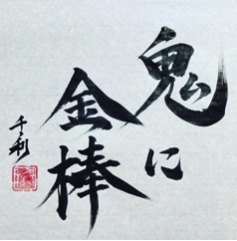
鬼に金棒
oni ni kanabō
The oni is the ogre of Japanese folklore – huge, horned and very strong. Now imagine giving it a giant iron club. Unbeatable! That is oni ni kanabō (鬼に金棒).
I’m Arasen, an elementary school principal and calligrapher in Japan. I love the “invincible” feeling of this proverb. Let me show you how to use it.
Quick Facts
| Japanese | 鬼に金棒 |
|---|---|
| Reading | おににかなぼう |
| Romaji | oni ni kanabō |
| Literally | An iron club for an ogre |
| Meaning | The strong get something that makes them even stronger. |
| English cousin | (No exact match) – like giving wings to a tiger |
What Does It Mean?
Someone who is already strong gets a good tool or condition and becomes even stronger.
It is always used in a good way – about a team, a person or a plan that becomes even more powerful.
Word by Word
| 鬼 | oni – ogre, demon of Japanese folklore |
|---|---|
| に | ni – to, for |
| 金棒 | kanabō – a heavy iron club, often studded with spikes |
Where Does It Come From?
In Japanese folk tales such as Momotarō (Peach Boy), the oni is a fearsome ogre, often drawn carrying a spiked iron club.
An oni is strong enough on its own. Give it a kanabō, and it becomes even stronger – that’s the picture behind the proverb. Every February at Setsubun, Japanese children throw beans to chase the oni away!
A Word from Arasen

Giving an iron club to an ogre who is already strong?! Just imagining it is scary – it would be ridiculously strong!
The iron club is the perfect tool for an ogre, isn’t it? I think the “perfect fit” is also the point. When someone who is already strong gets the perfect advantage, they become even stronger.
For example, when a skilled new member joins an already strong team, the team becomes even stronger. It’s used in a good way.
I love the feeling of being unbeatable when you say “oni ni kanabō”!
(Translated from Arasen’s original Japanese.)
How to Use It
A Short Skit

Yusuke, have you heard? Matsuzaka, the ace of A Elementary School – the newspaper said he throws a 130 km/h fastball. And now he’s learned a forkball, too!
勇輔くん、知っている。A小学校のエースの松坂くん。小学生で130キロのストレート投げって新聞に出てたけど、フォークボールも覚えた見たいよWhaaat?! A 130 km/h fastball AND a forkball?! That’s totally oni ni kanabō!
えええええ、130キロのストレートに、フォークボールまでの投げんか!!!まさに鬼に金棒やな“Chan-chan” is the little “ta-da!” sound that closes a comedy skit in Japan.
Example Sentences
- My brother is already a fast runner, and now he has new spikes. Oni ni kanabō!
足の速い兄が新しいスパイクを手に入れて、鬼に金棒だ。 - If that smart girl joins our team, it will be oni ni kanabō.
頭のいい彼女がチームに入ってくれたら、鬼に金棒だね。
Similar Japanese Proverbs
- 虎に翼Tora ni tsubasa
“Wings for a tiger.” A strong tiger with wings – the same meaning. - 弁慶に薙刀Benkei ni naginata
“A halberd for Benkei.” Benkei was a legendary warrior monk – give him his favorite weapon and he’s even stronger.
Similar Sayings in English
- like giving wings to a tiger
- That makes him even stronger.
English doesn’t have one perfect match – so why not try saying “oni ni kanabō” instead?
Quick Quiz
Which proverb has a similar meaning to oni ni kanabō?
- A. Tora ni tsubasa (虎に翼)
- B. Neko ni koban (猫に小判)
- C. Tsuki to suppon (月とすっぽん)
Show the answer
The answer is A. Tora ni tsubasa – “wings for a tiger.” Both mean the strong becoming even stronger.
Free Worksheet for Teachers
Teaching Japanese? Download a free printable worksheet for this proverb – with the skit, a fill-in-the-blank, a quiz and a writing task (10 proverbs, A4, with answer key).