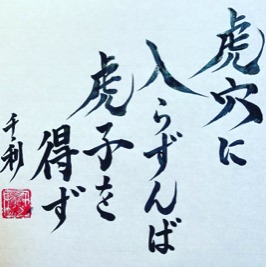
虎穴に入らずんば虎子を得ず
koketsu ni irazunba koji o ezu
Need a push to be brave? This proverb is the one: koketsu ni irazunba koji o ezu (虎穴に入らずんば虎子を得ず).
I’m Arasen, an elementary school principal and calligrapher in Japan. It comes from an ancient Chinese general – and in our skit, from a boy trying to talk to the girl he likes!
Quick Facts
| Japanese | 虎穴に入らずんば虎子を得ず |
|---|---|
| Reading | こけつにいらずんばこじをえず |
| Romaji | koketsu ni irazunba koji o ezu |
| Literally | If you don’t enter the tiger’s den, you won’t get the tiger’s cub |
| Meaning | Without taking risks, you can’t achieve great success. |
| Opposite | 君子危うきに近寄らず – a wise person stays away from danger |
| English cousin | Nothing ventured, nothing gained. |
What Does It Mean?
You can’t achieve great success without taking some risk.
Word by Word
| 虎穴 | koketsu – a tiger’s den |
|---|---|
| に入らずんば | ni irazunba – if you don’t go into (old, literary Japanese) |
| 虎子 | koji – a tiger’s cub |
| を得ず | o ezu – you won’t get |
Where Does It Come From?
The words come from ancient China. The general Ban Chao (班超) of the Han dynasty used them to encourage his frightened soldiers when a strong enemy was near: “Be brave!”
They won the battle – and the words became a proverb.
A Word from Arasen

“If you don’t have the courage to take a risk, you won’t win big!” – this proverb pushes you forward.
Koketsu is a cave where a tiger lives. Koji is a tiger’s cub.
It says: if you want the tiger’s cub, you have to go into the dangerous cave. Pretty scary!
It comes from old China, where these words were said to frightened soldiers: “Find your courage!” And they won.
(Translated from Arasen’s original Japanese.)
How to Use It
A Short Skit

I want to talk to Naoko, the girl I like, but she’s always with a group of girls. I can’t get near her. What should I do?
好きな直子ちゃんに話しかけたいねんけど、女の子たちでかたまっていて近寄れへんわ。どうしよう。Koketsu ni irazunba koji o ezu! Walk right in. Be brave, Ryosuke!
虎穴に入らずんば虎子を得ず、間をわって入っていきなさい。亮介、勇気を出せ!“Chan-chan” is the little “ta-da!” sound that closes a comedy skit in Japan.
Example Sentences
- I bravely asked the teacher a question, and finally understood. Koketsu ni irazunba koji o ezu.
思い切って先生に質問したら、よくわかった。虎穴に入らずんば虎子を得ずだ。 - Koketsu ni irazunba koji o ezu – let’s take on the tough tournament.
虎穴に入らずんば虎子を得ずで、むずかしい大会にちょうせんしてみよう。
Similar Japanese Proverbs
- 危ない橋も一度は渡れAbunai hashi mo ichido wa watare
“Cross a dangerous bridge at least once.” Sometimes you must take a risk.
The Opposite
- 君子危うきに近寄らずKunshi ayauki ni chikayorazu
“A wise person doesn’t go near danger.”
Similar Sayings in English
- Nothing ventured, nothing gained.
- Who dares wins.
Quick Quiz
Which English proverb has the same meaning?
- A. Look before you leap.
- B. Nothing ventured, nothing gained.
- C. Time is money.
Show the answer
The answer is B. Without risk, there’s no great success.
Watch the Lesson (in Japanese)
On my YouTube channel “Kyō kara tsukaeru kotowaza kōza” (Proverbs You Can Use from Today), I explain proverbs with short comedy skits. It’s in Japanese – a fun challenge for learners!
Free Worksheet for Teachers
Teaching Japanese? Download a free printable worksheet for this proverb – with the skit, a fill-in-the-blank, a quiz and a writing task (10 proverbs, A4, with answer key).
Read More
- 30 Japanese Proverbs (Kotowaza) with Meanings – all in one place
- Nanakorobi Yaoki (七転び八起き) – Fall Seven Times, Stand Up Eight
- Ishi no Ue ni mo Sannen (石の上にも三年) – Three Years on a Cold Stone
- Senri no Michi mo Ippo kara (千里の道も一歩から) – A Journey of a Thousand Miles Begins with One Step
- 虎穴に入らずんば虎子を得ず(日本語の記事)
- ことわざ 目次(250+ proverbs in Japanese)