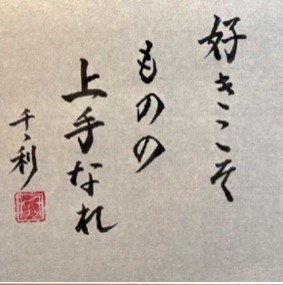
好きこそものの上手なれ
suki koso mono no jōzu nare
What could you do for hours without getting tired? Japanese has a proverb that says that’s exactly where your talent lies: suki koso mono no jōzu nare (好きこそものの上手なれ).
I’m Arasen, an elementary school principal and calligrapher in Japan. It goes back to Japan’s most famous tea master. Let me tell you.
Quick Facts
| Japanese | 好きこそものの上手なれ |
|---|---|
| Reading | すきこそもののじょうずなれ |
| Romaji | suki koso mono no jōzu nare |
| Literally | Liking (it) is exactly what makes one skillful |
| Meaning | You get good at what you love. |
| Opposite | 下手の横好き (heta no yokozuki) – “loving it but being bad at it” |
| English cousin | What one likes, one will do well. |
What Does It Mean?
When you love something, you work hard at it without even noticing – so you improve very quickly.
Word by Word
| 好き | suki – liking, loving |
|---|---|
| こそ | koso – “exactly this”, a word that adds strong emphasis |
| ものの上手 | mono no jōzu – being skillful at things |
| なれ | nare – is, becomes (old Japanese) |
Where Does It Come From?
It comes from an old way of saying “Loving something is exactly what makes you good at it.”
Koso … nare is a grammar pattern from classical Japanese called kakari-musubi: koso emphasizes a word, and the sentence ends in a special form.
About 500 years ago, the tea master Sen no Rikyū wrote a poem: “Skill, practice and love – of these three, it is love that makes you truly good.”
A Word from Arasen

When you’re doing something you love, time flies, doesn’t it?
You can keep at it without even feeling it’s hard work, so you keep getting better. Things you love, you get good at before you know it – that’s the advice from people long ago.
About 500 years ago, Sen no Rikyū, the great master of the tea ceremony, wrote that of skill, practice and love, it is love that makes you good.
To get better at something, “I love it!” is the best fuel.
What do you love? If you dig deep into the things you naturally get absorbed in, you might even become an expert.
(Translated from Arasen’s original Japanese.)
How to Use It
A Short Skit

Nozomi, your cookies are so delicious. They seem even better than before!
のぞみちゃんが作ってくれるクッキー、本当に美味しいね。前よりも美味しくなったみたいよ。Thanks, Miho. Suki koso mono no jōzu nare! I love baking cookies, so I keep trying new ideas.
美保ちゃん、ありがとう。好きこそ物の上手なれ だよ。私、クッキー作りが大好きで楽しいから、あれこれと工夫しているのよ。Nozomi, that’s amazing!
のぞみちゃん、すごい!!!“Chan-chan” is the little “ta-da!” sound that closes a comedy skit in Japan.
Example Sentences
- My brother loves trains – suki koso mono no jōzu nare – and he has memorized station names all over Japan.
電車が大好きな弟は、好きこそものの上手なれで、全国の駅名を覚えてしまった。 - She loves drawing, and suki koso mono no jōzu nare: she won a prize in a contest.
絵をかくのが好きな彼女は、好きこそものの上手なれで、コンクールに入賞した。
Similar Japanese Proverbs
- 好きは上手のもとSuki wa jōzu no moto
“Love is the root of skill.” The same idea in other words.
The Opposite
- 下手の横好きHeta no yokozuki
“Bad at it, but loves it anyway.” Loving a hobby without being good at it.
Similar Sayings in English
- What one likes, one will do well.
- Love what you do, and you’ll do it well.
Quick Quiz
Which proverb has the opposite meaning?
- A. Heta no yokozuki (loving it but bad at it)
- B. Ishi no ue ni mo sannen (three years on a stone)
- C. Saru mo ki kara ochiru (even monkeys fall from trees)
Show the answer
The answer is A. Heta no yokozuki – loving something without being good at it.
Watch the Lesson (in Japanese)
On my YouTube channel “Kyō kara tsukaeru kotowaza kōza” (Proverbs You Can Use from Today), I explain proverbs with short comedy skits. It’s in Japanese – a fun challenge for learners!
Free Worksheet for Teachers
Teaching Japanese? Download a free printable worksheet for this proverb – with the skit, a fill-in-the-blank, a quiz and a writing task (10 proverbs, A4, with answer key).