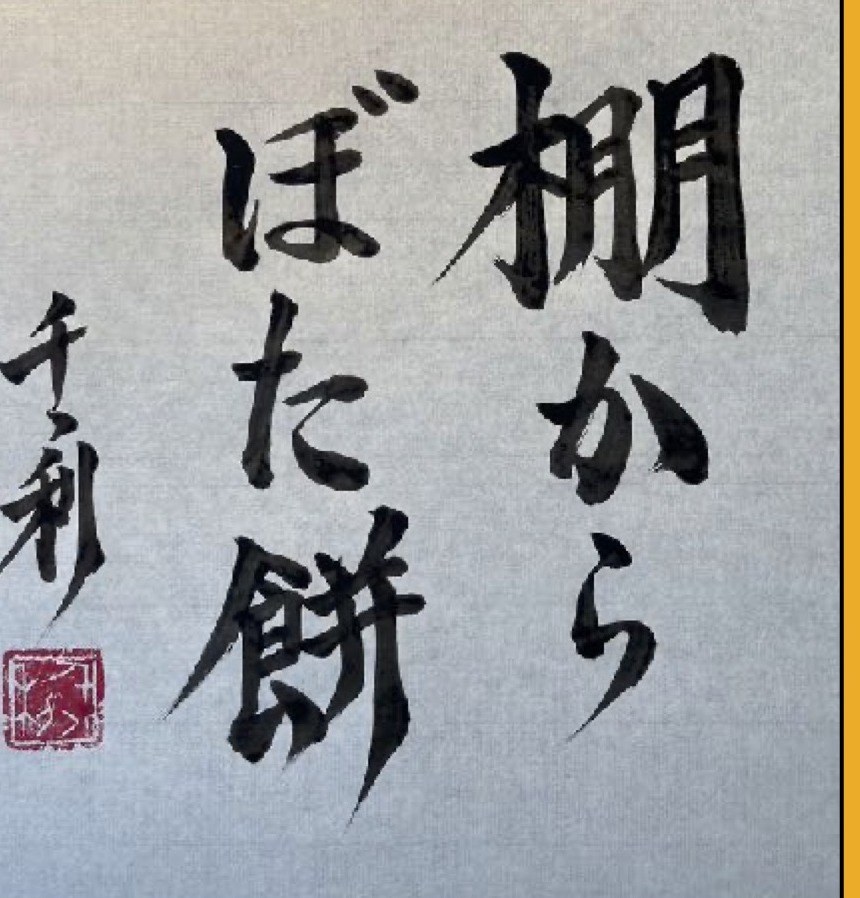
棚からぼた餅
tana kara botamochi
Imagine lying under a shelf with your mouth open – and a sweet rice cake drops right in! That is tana kara botamochi (棚からぼた餅), or tanabota for short.
I’m Arasen, an elementary school principal and calligrapher in Japan. Japanese people use tanabota every day. Let me show you how.
Quick Facts
| Japanese | 棚からぼた餅 |
|---|---|
| Reading | たなからぼたもち |
| Romaji | tana kara botamochi |
| Literally | A botamochi from the shelf |
| Meaning | A lucky windfall that comes without any effort. |
| Short form | 棚ぼた (tanabota) – used in everyday speech |
| English cousin | A windfall. / Pennies from heaven. |
What Does It Mean?
Unexpected good luck that comes to you without doing anything.
Word by Word
| 棚から | tana kara – from the shelf |
|---|---|
| 牡丹餅 | botamochi – a sweet rice cake covered in red bean paste |
Where Does It Come From?
Picture this: you’re under a shelf, and your favorite sweet, a botamochi, falls straight into your mouth.
Botamochi are sweets offered to the Buddha during ohigan, the spring and autumn equinox weeks. Long ago, they were a real luxury.
A Word from Arasen

An easy infield fly – out! But a sudden gust of wind makes the fielder lose balance and drop it. That kind of luck is called tana kara botamochi.
It means getting unexpected good luck without any effort.
The short form is tanabota.
Botamochi is a sweet offered to the Buddha at ohigan. For people long ago, it was a luxury.
Lying with your mouth open, and a botamochi suddenly falls from the shelf into it – super lucky! You’d wish that happened all the time.
But me? I don’t look for tanabota. I’d rather set a goal, work at it steadily, and get a big result. I really feel that way of life is happier.
(Translated from Arasen’s original Japanese.)
How to Use It
A Short Skit
I was out for a walk and bumped into my great-uncle – and he gave me pocket money! So lucky!
今日、散歩してたら親戚のおじいさんに偶然に会って、お小遣いをもらってもうたわ!!超ラッキーやわ。That’s totally tana kara botamochi!
まさに棚からぼた餅やん。“Chan-chan” is the little “ta-da!” sound that closes a comedy skit in Japan.
Example Sentences
- I happened to win a travel voucher in a raffle. Tana kara botamochi!
くじびきで、たまたま旅行券が当たった。棚からぼた餅だ。 - Waiting for tana kara botamochi won’t get you anywhere.
棚からぼた餅を待っていても、何も始まらない。
Similar Japanese Proverbs
- 開いた口へ牡丹餅Aita kuchi e botamochi
“A botamochi into an open mouth.” The same lucky picture.
The Opposite
- 蒔かぬ種は生えぬMakanu tane wa haenu
“Seeds you don’t sow won’t grow.” Without effort, no results.
Similar Sayings in English
- A windfall.
- Pennies from heaven.
Korea has almost the same picture: “a rice cake that fell from the shelf.”
Quick Quiz
What is the short form of tana kara botamochi?
- A. tanabota
- B. botamochi
- C. tanamochi
Show the answer
The answer is A. tanabota – used all the time in everyday Japanese.
Watch the Lesson (in Japanese)
On my YouTube channel “Kyō kara tsukaeru kotowaza kōza” (Proverbs You Can Use from Today), I explain proverbs with short comedy skits. It’s in Japanese – a fun challenge for learners!
Free Worksheet for Teachers
Teaching Japanese? Download a free printable worksheet for this proverb – with the skit, a fill-in-the-blank, a quiz and a writing task (10 proverbs, A4, with answer key).