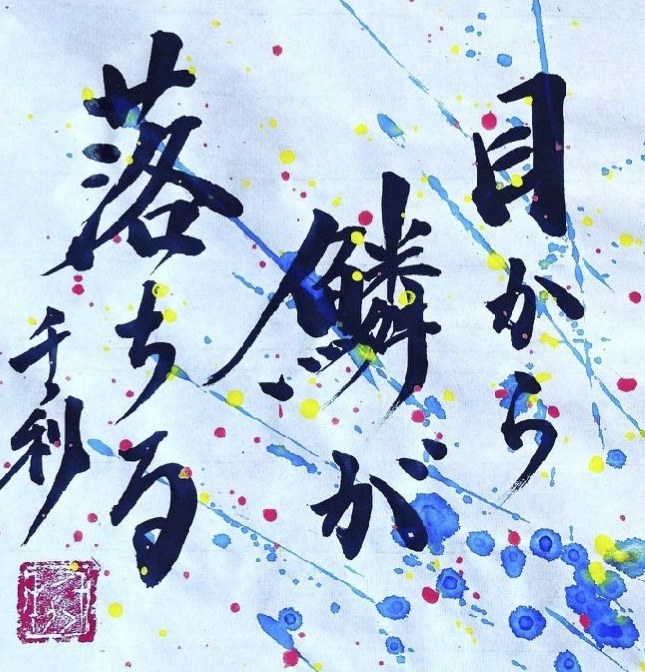
目から鱗が落ちる
me kara uroko ga ochiru
Here’s a surprise: one of Japan’s most-used sayings comes from the Bible. Me kara uroko ga ochiru (目から鱗が落ちる) – “scales fall from the eyes.”
I’m Arasen, an elementary school principal and calligrapher in Japan. Japanese people say it (or just “me-uroko!”) whenever they have an “aha!” moment.
Quick Facts
| Japanese | 目から鱗が落ちる |
|---|---|
| Reading | めからうろこがおちる |
| Romaji | me kara uroko ga ochiru |
| Literally | Scales fall from the eyes |
| Meaning | Suddenly understanding something clearly. |
| Origin | The New Testament (Acts 9) |
| English cousin | The scales fell from my eyes. |
What Does It Mean?
Something you couldn’t understand suddenly becomes clear, thanks to some trigger.
Casual Japanese often shortens it to me-uroko (目から鱗): “That was a total eye-opener!”
Word by Word
| 目から | me kara – from the eyes |
|---|---|
| 鱗 | uroko – scales (like a fish’s) |
| が落ちる | ga ochiru – fall |
Where Does It Come From?
It comes from the New Testament. After Saul was blinded, “something like scales fell from his eyes, and he could see again.”
At first, the saying meant waking up from confusion or a wrong belief. Today it means any moment when you suddenly see the truth of something.
A Word from Arasen

This proverb means the scales over your eyes fall off and you can see clearly – something you never understood suddenly becomes clear.
It was originally words from the Bible: “Something like scales fell from Saul’s eyes, and he could see again. He got up, was baptized, and after eating, regained his strength.”
According to the Bible, Saul realized that what he had done was wrong, and woke up from his confusion.
So at first, it meant waking up from confusion. Today it means a moment when suddenly everything opens up and you see the truth – or even when a person changes completely.
I’ve had a “scales falling from my eyes” moment, too. A teacher I respect taught me how to overcome hardship: give the hardship a meaning.
“If I get through this, I’ll be stronger.” “It’s a chance to grow.” “If I solve it, I can give hope to others with the same struggle.” When you give hardship a meaning, it becomes the power that moves you forward.
When I heard that, the scales fell from my eyes. It was like fog clearing away. I’m grateful to my teacher.
(Translated from Arasen’s original Japanese.)
How to Use It
A Short Skit
Yusuke, Chinese people are so smart. They invented kanji, after all!
勇輔、中国の人って頭ええよな。なにしろ、漢字を作ったんやから。Ryosuke, did you know Japanese people made their own kanji too?
亮介、日本人も、まねして、漢字作ったん知ってる?Really? Japanese kanji? Is there such a thing?
えっ、そうなん。日本の漢字・・。そんなんあるの?Yes, they’re called kokuji. Like 畑 (field): fire 火 + rice paddy 田 – a paddy with the water burned away.
そう、国字って言うねん。例えば「畑」っていう字あるやろ。火をつけて水を無くした田のこと。I see! Wow – me kara uroko ga ochita! Japanese people are smart too!
なるほど!驚いたわ。目から鱗が落ちたようやわ。日本人も頭ええなぁ。“Chan-chan” is the little “ta-da!” sound that closes a comedy skit in Japan.
Example Sentences
- When the teacher explained it, the scales fell from my eyes and I finally understood division.
先生の説明を聞いて、目から鱗が落ちるように、わり算のしくみがわかった。 - Reading that book, I felt the scales fall from my eyes.
その本を読んで、目から鱗が落ちる思いがした。
Similar Sayings in English
- The scales fell from my eyes.
- It was an eye-opener.
- a lightbulb moment
Other languages say it too: “The veil fell from my eyes” (Russia), “The bandage fell from my eyes” (Spain), “My head got brighter” (Romania).
Quick Quiz
Where does me kara uroko ga ochiru come from?
- A. An old Chinese story
- B. The Bible
- C. A Japanese folk tale
Show the answer
The answer is B. The Bible – from a story in the New Testament.
Watch the Lesson (in Japanese)
On my YouTube channel “Kyō kara tsukaeru kotowaza kōza” (Proverbs You Can Use from Today), I explain proverbs with short comedy skits. It’s in Japanese – a fun challenge for learners!
Free Worksheet for Teachers
Teaching Japanese? Download a free printable worksheet for this proverb – with the skit, a fill-in-the-blank, a quiz and a writing task (10 proverbs, A4, with answer key).