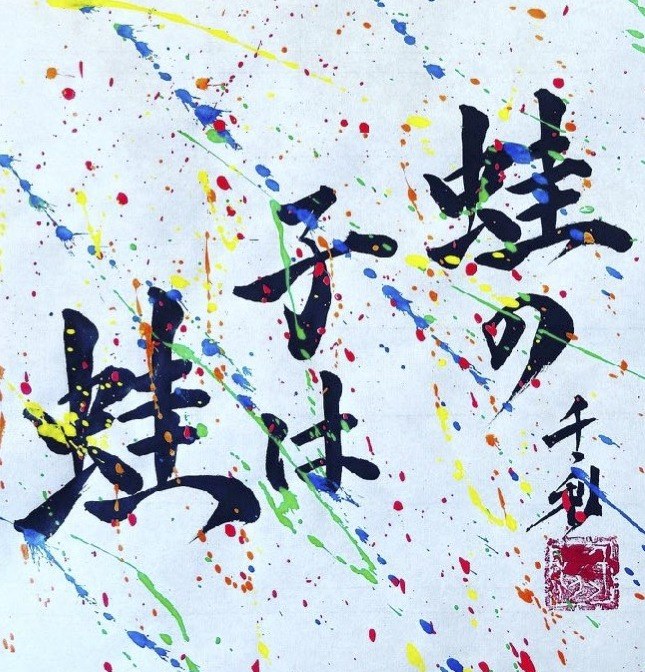
蛙の子は蛙
kaeru no ko wa kaeru
A tadpole looks nothing like a frog – but it becomes one in the end. That is kaeru no ko wa kaeru (蛙の子は蛙), the Japanese “like father, like son.”
I’m Arasen, an elementary school principal and calligrapher in Japan. I’ll explain how to use it politely – and why, as an educator, I gently disagree with it!
Quick Facts
| Japanese | 蛙の子は蛙 |
|---|---|
| Reading | かえるのこはかえる |
| Romaji | kaeru no ko wa kaeru |
| Literally | A frog’s child is a frog |
| Meaning | Children turn out like their parents. |
| Opposite | 鳶が鷹を生む (tobi ga taka o umu) – “a kite gives birth to a hawk” |
| English cousin | Like father, like son. / The apple doesn’t fall far from the tree. |
What Does It Mean?
Children end up resembling their parents.
Traditionally it meant “ordinary parents have ordinary children,” so it is used about your own family, humbly – using it about someone else’s child can be rude.
Word by Word
| 蛙 | kaeru – frog |
|---|---|
| の子は | no ko wa – the child of |
| 蛙 | kaeru – (is) a frog |
Where Does It Come From?
A tadpole looks completely different from its parents, with a tail like a little fish. But as it grows, the tail disappears, legs appear – and it becomes a frog after all.
From this came the idea that children grow up to be like their parents.
A Word from Arasen

When a frog’s egg hatches, it becomes a tadpole. With its tail, it doesn’t look like a frog’s child at all – more like a catfish!
But as it grows, the tail goes, the legs come – and in the end, it’s a frog.
Traditionally, this proverb was used in a negative way: ordinary parents have ordinary children. It’s also a humble expression about yourself, so using it about others can be rude.
But as an educator, I’m convinced that children of ordinary parents can become amazing people, as long as they are given a good environment. I’m still in touch with many of my former students, now grown up – so I can say it with confidence!
You might think, “Why introduce a proverb and then argue with it?” Proverbs are deep, aren’t they?
(Translated from Arasen’s original Japanese.)
How to Use It
A Short Skit
Nozomi, I heard you became an elementary school teacher!
のぞみ、小学校の教師になってんて。That’s right. Mom and Dad are both teachers, so – kaeru no ko wa kaeru – I became one too!
そうやねん。お父さんもお母さんも教師やから、蛙の子は蛙で、私もやっぱり教師になってしもたわ。“Chan-chan” is the little “ta-da!” sound that closes a comedy skit in Japan.
Example Sentences
- The soccer player’s kids are great at soccer too. Kaeru no ko wa kaeru.
サッカー選手の子どもも、やっぱりサッカーが上手だ。蛙の子は蛙だね。 - They say kaeru no ko wa kaeru, but I have a dream different from my parents’.
蛙の子は蛙というけれど、ぼくは親とはちがう夢を持っている。
Similar Japanese Proverbs
- 瓜の蔓に茄子はならぬUri no tsuru ni nasubi wa naranu
“Eggplants don’t grow on melon vines.” Children take after their parents.
The Opposite
- 鳶が鷹を生むTobi ga taka o umu
“A kite gives birth to a hawk.” Ordinary parents can have an extraordinary child.
Similar Sayings in English
- Like father, like son.
- The apple doesn’t fall far from the tree.
In Russia they say “The apple falls near the apple tree,” and in Indonesia, “A horse’s child is a horse, a donkey’s child is a donkey.”
Quick Quiz
Which proverb has the opposite meaning?
- A. Tobi ga taka o umu (鳶が鷹を生む)
- B. Uri no tsuru ni nasubi wa naranu
- C. Oni ni kanabō
Show the answer
The answer is A. “A kite gives birth to a hawk” – ordinary parents with an outstanding child.
Watch the Lesson (in Japanese)
On my YouTube channel “Kyō kara tsukaeru kotowaza kōza” (Proverbs You Can Use from Today), I explain proverbs with short comedy skits. It’s in Japanese – a fun challenge for learners!
Free Worksheet for Teachers
Teaching Japanese? Download a free printable worksheet for this proverb – with the skit, a fill-in-the-blank, a quiz and a writing task (10 proverbs, A4, with answer key).
Read More
- 30 Japanese Proverbs (Kotowaza) with Meanings – all in one place
- Nasake wa Hito no Tame Narazu (情けは人のためならず) – Kindness Is Not Just for Others
- Sannin Yoreba Monju no Chie (三人寄れば文殊の知恵) – Three Heads Make the Wisdom of Monju
- Rui wa Tomo o Yobu (類は友をよぶ) – Like Calls to Like
- 蛙の子は蛙(日本語の記事)
- ことわざ 目次(250+ proverbs in Japanese)