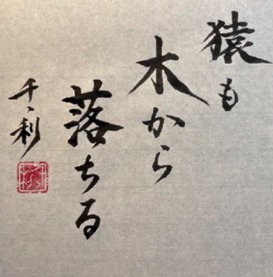
猿も木から落ちる
saru mo ki kara ochiru
Monkeys are the champions of climbing trees. But even a monkey slips sometimes! That is the picture behind saru mo ki kara ochiru (猿も木から落ちる), one of the first proverbs Japanese children learn.
I’m Arasen, an elementary school principal and calligrapher in Japan. Let me show you what it means, how to use it kindly, and a classroom skit where even the teacher slips up.
Quick Facts
| Japanese | 猿も木から落ちる |
|---|---|
| Reading | さるもきからおちる |
| Romaji | saru mo ki kara ochiru |
| Literally | Even monkeys fall from trees |
| Meaning | Even experts make mistakes. |
| English cousin | Even Homer sometimes nods. / Nobody is perfect. |
What Does It Mean?
However skilled someone is, they can still make a mistake.
It is often used to comfort someone who is usually very good at something – or to laugh off your own mistake.
Word by Word
| 猿 | saru – monkey |
|---|---|
| も | mo – even |
| 木から | ki kara – from a tree (ki = tree, kara = from) |
| 落ちる | ochiru – to fall |
Where Does It Come From?
Monkeys are famous for climbing trees. Yet even a monkey can lose its grip and fall.
From this simple picture came the lesson: the best in any field can still fail sometimes. Japan has many proverbs with the same idea – which shows how much Japanese people like to forgive mistakes with a smile!
A Word from Arasen

The monkey is a master of climbing trees, but even it falls sometimes. In the same way, people who are excellent at something can also make mistakes.
Imagine the captain of your team – the one everyone trusts completely. Then one day, the captain’s shot goes way off target. Everyone, including the captain, turns pale: “Whaaat?!” That’s the moment to say, “Hey – saru mo ki kara ochiru!”
Since long ago, this proverb has been used to cheer people up after a mistake.
And when you make a mistake, you can use it to go easy on yourself, too.
(Translated from Arasen’s original Japanese.)
How to Use It
A Short Skit
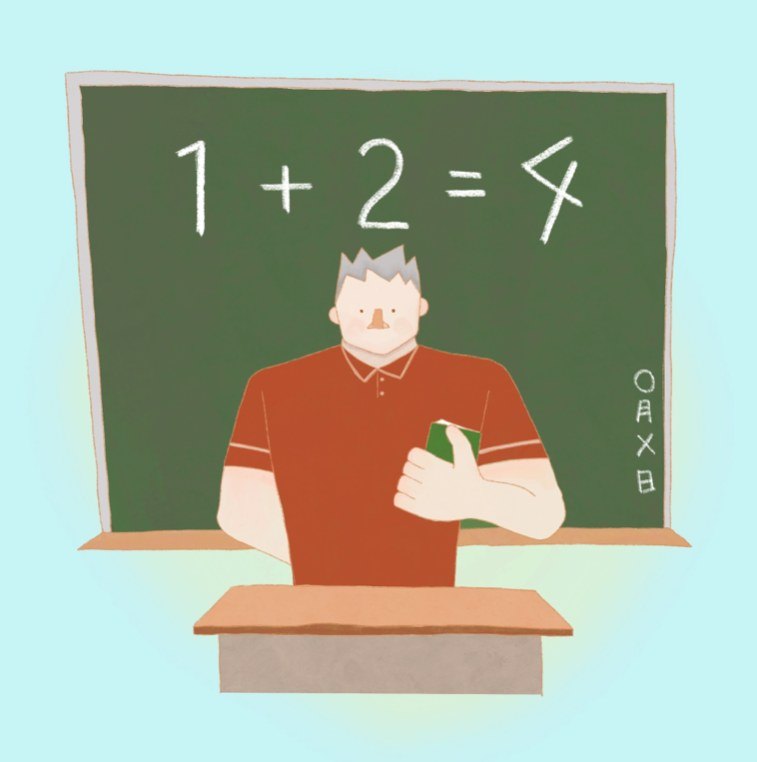
So, the answer to this problem is this. Does everyone understand?
この問題の式は、こうなります。みんなわかりましたかMr. Kagawa… I think 1 + 2 is 3, not 4.
香川先生、1+2=4じゃなくて、3だと思いますThank you, Nozomi. Oh dear – and I’m the teacher… How embarrassing…
のぞみさん、ご指摘ありがとう。先生としたことが…。恥ずかしい…。Mr. Kagawa, you know what they say: saru mo ki kara ochiru. Don’t worry about it!
香川先生、『猿も木から落ちる』っていうじゃないですか。どんまいです。“Chan-chan” is the little “ta-da!” sound that closes a comedy skit in Japan.
Example Sentences
- My big sister is a great swimmer, but she nearly drowned in the pool. Saru mo ki kara ochiru!
水泳が得意な姉がプールでおぼれかけるなんて、猿も木から落ちるだね。 - Even a veteran teacher sometimes calls a student by the wrong name. Saru mo ki kara ochiru.
ベテランの先生でも名前をまちがえることがある。猿も木から落ちるものだ。
Similar Japanese Proverbs
- 弘法にも筆の誤りKōbō ni mo fude no ayamari
“Even Kōbō makes a slip of the brush.” Kōbō Daishi was a legendary master calligrapher – as a calligrapher, this is my favorite! - 河童の川流れKappa no kawa-nagare
“Even a kappa gets swept away by the river.” The kappa is a water spirit from Japanese folklore – a great swimmer. - 上手の手から水が漏るJōzu no te kara mizu ga moru
“Water leaks even from a skilled hand.” Experts slip up, too.
Similar Sayings in English
- Even Homer sometimes nods.
- Nobody is perfect.
“Even Homer sometimes nods” means that even the great Greek poet Homer had his weak moments – the same idea as our monkey!
Quick Quiz
Which one does not have a similar meaning to saru mo ki kara ochiru?
- A. Kappa no kawa-nagare (河童の川流れ)
- B. Kōbō ni mo fude no ayamari (弘法にも筆の誤り)
- C. Oni ni kanabō (鬼に金棒)
Show the answer
The answer is C. Oni ni kanabō. It means “the strong become even stronger” – not about making mistakes.
Free Worksheet for Teachers
Teaching Japanese? Download a free printable worksheet for this proverb – with the skit, a fill-in-the-blank, a quiz and a writing task (10 proverbs, A4, with answer key).
Read More
- 30 Japanese Proverbs (Kotowaza) with Meanings – all in one place
- I no Naka no Kawazu (井の中の蛙大海を知らず) – A Frog in a Well Knows Nothing of the Great Ocean
- Fukusui Bon ni Kaerazu (覆水盆に返らず) – Spilled Water Never Returns to the Tray
- No Aru Taka wa Tsume o Kakusu (能ある鷹は爪をかくす) – The Skilled Hawk Hides Its Talons
- 猿も木から落ちる(日本語の記事)
- ことわざ 目次(250+ proverbs in Japanese)