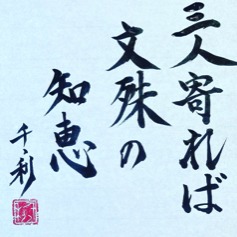
三人寄れば文殊の知恵
sannin yoreba monju no chie
Stuck on a problem? Don’t think alone! Japanese people say sannin yoreba monju no chie (三人寄れば文殊の知恵).
I’m Arasen, an elementary school principal and calligrapher in Japan. It’s the Japanese “two heads are better than one” – only with three heads, and a Buddhist figure of wisdom.
Quick Facts
| Japanese | 三人寄れば文殊の知恵 |
|---|---|
| Reading | さんにんよればもんじゅのちえ |
| Romaji | sannin yoreba monju no chie |
| Literally | If three people gather, (they have) the wisdom of Monju |
| Meaning | Ordinary people, thinking together, can come up with great ideas. |
| Opposite | 船頭多くして船山に上る – too many captains send the boat up a mountain |
| English cousin | Two heads are better than one. |
What Does It Mean?
Even ordinary people can come up with a good idea when three of them talk it over together.
Word by Word
| 三人 | sannin – three people |
|---|---|
| 寄れば | yoreba – if they gather |
| 文殊 | Monju – Monju Bosatsu (Manjushri), the Buddhist figure of wisdom |
| の知恵 | no chie – the wisdom of |
Where Does It Come From?
Monju (Manjushri) is a bodhisattva in Buddhism, honored as the symbol of wisdom.
The proverb says: even ordinary people, when three of them think together, can come up with ideas as wise as Monju’s.
A Word from Arasen

“I can’t come up with a good idea…” When that happens, try getting three people together to talk.
Anyone, if three people discuss it, can find a good idea. That’s the advice from people long ago.
Monju is a Buddhist figure of wisdom. In other words, even ordinary people, working together, can produce the “wisdom of Monju.”
Of course, gathering ordinary people doesn’t guarantee genius. But everyone is different, so something new can come out that none of us had alone.
(Translated from Arasen’s original Japanese.)
How to Use It
A Short Skit
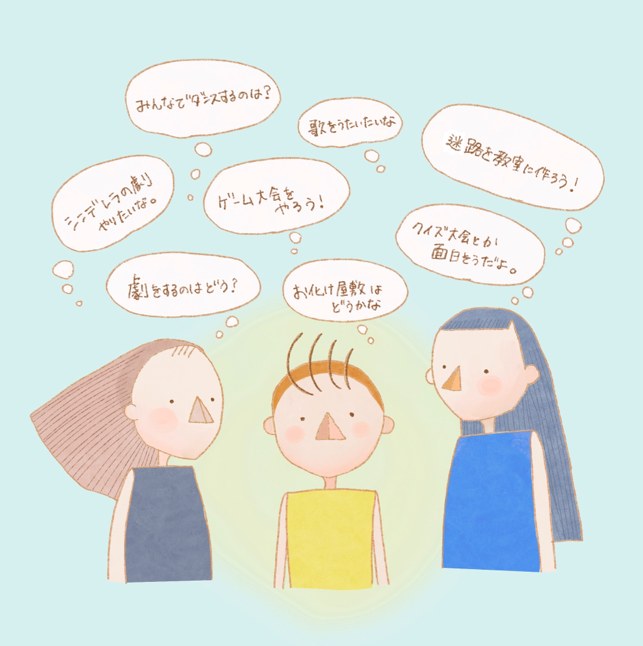
Nozomi, our class is having a party next week, but I have no idea what we should do for our show.
のぞみお姉ちゃん、来週にクラスでお楽しみ会をするんだけど、どんな出し物をしたらいいか、全然思い浮かばへんねん。Then let’s think about it together, Yusuke. Sannin yoreba monju no chie, as they say!
勇輔、それじゃみんなで考えようか。三人寄れば文殊の知恵って言うしね“Chan-chan” is the little “ta-da!” sound that closes a comedy skit in Japan.
Example Sentences
- A problem I couldn’t solve alone, we solved together. Sannin yoreba monju no chie.
一人ではわからなかった問題も、三人寄れば文殊の知恵で、みんなで考えたら解けた。 - Sannin yoreba monju no chie – let’s decide as a group.
三人寄れば文殊の知恵というから、班で話し合って決めよう。
Similar Japanese Proverbs
- 衆知を集めるShūchi o atsumeru
“Gather the wisdom of many.” Bring everyone’s ideas together.
The Opposite
- 船頭多くして船山に上るSendō ōku shite fune yama ni noboru
“Too many captains, and the boat climbs a mountain.” Too many leaders spoil things – like “too many cooks spoil the broth.”
Similar Sayings in English
- Two heads are better than one.
- Many hands make light work.
A Tibetan saying goes, “Even ordinary people become wise when three of them talk it over.”
Quick Quiz
Who is “Monju” (文殊)?
- A. A famous scholar
- B. Three brothers
- C. A Buddhist figure of wisdom
Show the answer
The answer is C. Monju Bosatsu (Manjushri) is the Buddhist symbol of wisdom.
Watch the Lesson (in Japanese)
On my YouTube channel “Kyō kara tsukaeru kotowaza kōza” (Proverbs You Can Use from Today), I explain proverbs with short comedy skits. It’s in Japanese – a fun challenge for learners!
Free Worksheet for Teachers
Teaching Japanese? Download a free printable worksheet for this proverb – with the skit, a fill-in-the-blank, a quiz and a writing task (10 proverbs, A4, with answer key).
Read More
- 30 Japanese Proverbs (Kotowaza) with Meanings – all in one place
- Nasake wa Hito no Tame Narazu (情けは人のためならず) – Kindness Is Not Just for Others
- Kaeru no Ko wa Kaeru (蛙の子は蛙) – The Child of a Frog Is a Frog
- Rui wa Tomo o Yobu (類は友をよぶ) – Like Calls to Like
- 三人寄れば文殊の知恵(日本語の記事)
- ことわざ 目次(250+ proverbs in Japanese)