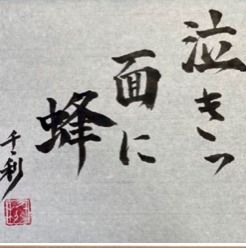
泣きっ面に蜂
nakittsura ni hachi
You forgot your homework, fell over in P.E., and then got scolded at home. Japanese has a proverb for days like that: nakittsura ni hachi (泣きっ面に蜂).
I’m Arasen, an elementary school principal and calligrapher in Japan. It’s the Japanese “when it rains, it pours.”
Quick Facts
| Japanese | 泣きっ面に蜂 |
|---|---|
| Reading | なきっつらにはち |
| Romaji | nakittsura ni hachi |
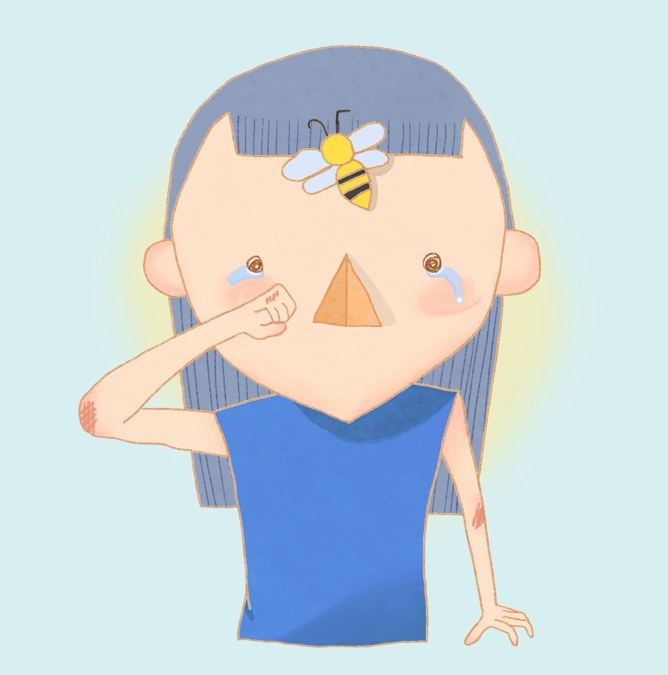
| Literally | A bee on a crying face |
| Meaning | Bad luck on top of bad luck. |
| English cousin | When it rains, it pours. |
What Does It Mean?
When something bad happens, something else bad comes on top of it.
Word by Word
| 泣きっ面 | nakittsura – a crying face (casual) |
|---|---|
| に | ni – on, onto |
| 蜂 | hachi – a bee, a wasp |
Where Does It Come From?
You’re already crying – and then a bee stings your face, and it hurts even more.
A Word from Arasen

This proverb is about something bad happening, and then something else bad piling on top.
You’re sad, your face is puffy from crying – and then a bee stings you, and your face swells up even more. Totally unlucky! You want to shout, “Why NOW?!”
In class, you need the bathroom and you’re wondering what to do – and just then the teacher says, “Arai-kun, solve this problem.” The worst!
But somehow, that kind of thing happens a lot.
This proverb is advice from people long ago: “Bad luck often comes in pairs.”
(Translated from Arasen’s original Japanese.)
How to Use It
A Short Skit
Kanae, today was the worst.
かなえ、今日は最悪だわWhat happened, Nozomi?
のぞみお姉ちゃん、どうしたの?I forgot my homework and got scolded by the teacher, I fell over in P.E. and everyone laughed, and when I got home Mom scolded me… The worst!!
だってさぁ、今日は宿題を忘れて先生に怒られるし、体育の授業では転んでしまって、みんなから笑われちゃうし、家に帰ったらお母さんに怒られるし…。もう最悪!!!Wow, the worst things all at once. That’s nakittsura ni hachi.
のぞみお姉ちゃん、ほんまに最悪が重なったな。まさに泣きっ面に蜂やな。I really am about to cry…
ほんまに泣きそう・・・。“Chan-chan” is the little “ta-da!” sound that closes a comedy skit in Japan.
Example Sentences
- I got soaked in the rain, then fell and scraped my knee. Nakittsura ni hachi.
雨でぬれたうえに、転んでひざをすりむいた。泣きっ面に蜂だ。 - I lost my wallet, and then my bike got a flat tire – nakittsura ni hachi!
財布を落とした日に、自転車までパンクするなんて泣きっ面に蜂だ。
Similar Japanese Proverbs
- 弱り目にたたり目Yowarime ni tatarime
“A curse on top of weakness.” More trouble when you’re already in trouble. - 一難去ってまた一難Ichinan satte mata ichinan
“One disaster leaves, another arrives.”
Similar Sayings in English
- When it rains, it pours.
- Misfortunes never come singly.
- to add insult to injury
Quick Quiz
Which proverb has a similar meaning to nakittsura ni hachi?
- A. Oni ni kanabō (an ogre with an iron club)
- B. Tana kara botamochi (a rice cake from the shelf)
- C. Yowarime ni tatarime (a curse on top of weakness)
Show the answer
The answer is C. Yowarime ni tatarime. Both describe bad things piling up.
Watch the Lesson (in Japanese)
On my YouTube channel “Kyō kara tsukaeru kotowaza kōza” (Proverbs You Can Use from Today), I explain proverbs with short comedy skits. It’s in Japanese – a fun challenge for learners!
Free Worksheet for Teachers
Teaching Japanese? Download a free printable worksheet for this proverb – with the skit, a fill-in-the-blank, a quiz and a writing task (10 proverbs, A4, with answer key).
Read More
- 50 Japanese Proverbs (Kotowaza) with Meanings – all in one place
- Ame Futte Ji Katamaru (雨ふって地固まる) – After the Rain, the Ground Grows Firm
- Ningen Banji Saio ga Uma (人間万事塞翁が馬) – The Old Man of the Frontier and His Horse
- Tana kara Botamochi (棚からぼた餅) – A Rice Cake Falling from the Shelf
- 泣きっ面に蜂(日本語の記事)
- ことわざ 目次(250+ proverbs in Japanese)